






Uh oh...
It appears that you're using a severely outdated version of Safari on Windows. Many features won't work correctly, and functionality can't be guaranteed. Please try viewing this website in Edge, Mozilla, Chrome, or another modern browser. Sorry for any inconvenience this may have caused!
Read More about this safari issue.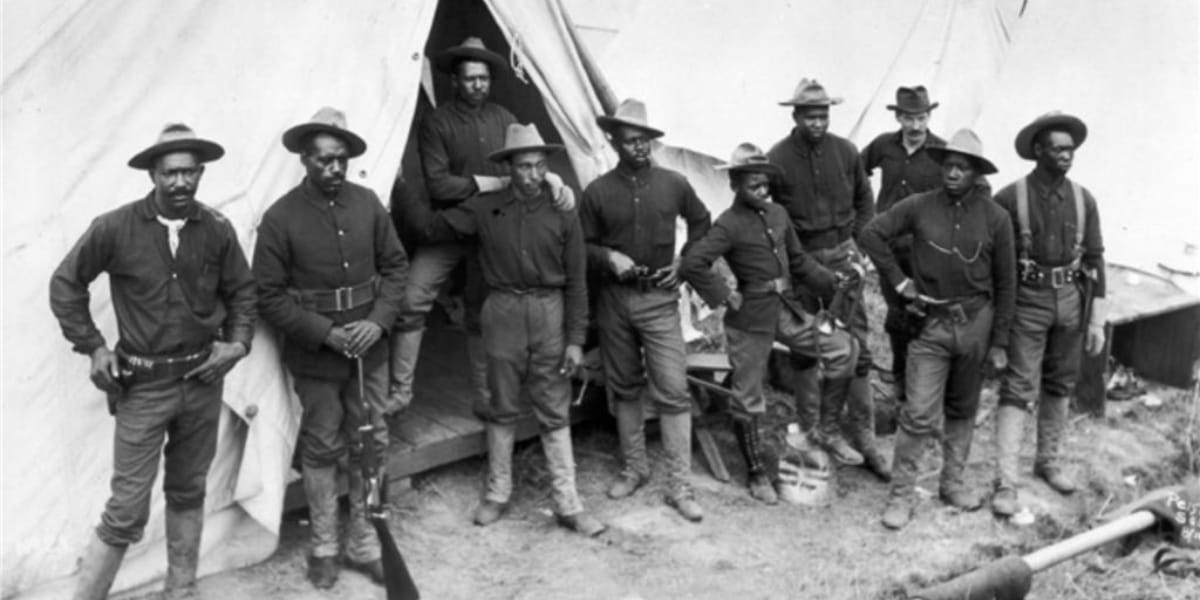

Arkansas has always influenced its people, especially those who carried its lessons far beyond the state’s borders. Born July 15, 1918, in Tamo, just southeast of Pine Bluff, William Jones grew up in the heart of the Delta. Tamo was a small, tightly knit African American farming community, where faith, responsibility, and perseverance were passed down through generations. Those early lessons never left him.
Although much of Jones’s adult life took place outside Arkansas, the lessons he learned from his grandparents, neighbors, and the rhythms of Delta life stayed with him through his military service and beyond. As one of the last surviving Buffalo Soldiers, Jones embodied an experience shared by many Black Arkansans of his time. His life tells a story not only of service but also of remembrance and choosing to preserve history so future generations could learn from it.

Who Was William Jones?
William Jones was the youngest of seven children born to farmers Joseph Jones and Elizabeth “Betty” Jones Mabrey. After his early childhood in Tamo, his family moved first to Oklahoma and then to Coffeyville, Kansas, where he attended segregated schools. In 1941, at age 22, Jones joined the United States Army. Because the military was still segregated, African American men were limited to a few units, including the elite 9th and 10th Cavalry, known as the Buffalo Soldiers.
Jones waited over a year to be accepted before earning his place in the 10th Cavalry, one of the Army’s most selective and respected units. His service took him around the world, through World War II and later into the Korean War, where he was captured and held as a prisoner of war. Still, Jones rarely spoke publicly about his suffering. Instead, he focused on education, legacy, and the importance of remembrance.
Who Were the Buffalo Soldiers
An act of Congress formed the Buffalo Soldiers in 1866 as segregated, all-Black Cavalry and infantry units. At first, they supported westward expansion by building forts, roads and telegraph lines, protecting settlers and mail routes, and playing a key role in the early development and safeguarding of national parks. They also served overseas in American conflicts, fought wildfires, guarded borders, and filled essential gaps in the nation’s expanding infrastructure.

The nickname “Buffalo Soldiers” was given by Indigenous peoples, a name believed to reference both the soldiers’ bravery and their curly hair, which resembled a buffalo’s mane. Despite facing discrimination within the military and society at large, these units earned a reputation for discipline, endurance and professionalism. Many Buffalo Soldiers came from Southern states, carrying lessons shaped by hardship, resilience and strong community ties.
Arkansas and the Buffalo Soldiers
Although Buffalo Soldier regiments were most often based west of Arkansas, their work was deeply connected to the state’s role as a gateway to the frontier. Arkansas sat at a crossroads of rivers, rail lines, and military routes that linked the Mississippi Delta to the expanding West. Through this network, Buffalo Soldiers helped move troops, supplies, and messages that influenced the region’s development.
Fort Smith was a key part of this system, serving as a crucial military and supply center. It connected Arkansas to Indian Territory and western posts. Buffalo Soldiers helped build, guard, and repair telegraph lines and transportation routes linking Fort Smith to other forts, railroads, and law enforcement across the frontier, enabling information and resources to move quickly and securely.
Beyond communication, Buffalo Soldiers escorted mail and supply trains, improved roads, and supported border enforcement along Arkansas’s western edge. Their labor stabilized key travel routes and reinforced federal presence in a rapidly changing landscape. Though often overlooked, this work helped shape Arkansas’s connection to westward expansion. It became part of the legacy carried on by Arkansans like William Jones, whose service reflected a long tradition of Black military contribution rooted in the state.
An Arkansas Man in a National Story
William Jones’s story is important because it is both personal and representative. He was not just an individual soldier, but a reflection of many Black Arkansans whose lives intersected with national events, often without recognition. His experience echoes that of many Arkansas families whose service, sacrifice and perseverance shaped American history, even when their names were omitted from textbooks.
The values instilled in the Delta helped sustain him through the hardships of military life, including captivity during the Korean War. Fellow prisoners called him “Preacher,” a reflection of his steadfast optimism and faith, which he credited to his upbringing. Even in the bleakest conditions, Jones focused on inspiring others, a leadership quality born on Arkansas soil.

Remembrance Matters
After retiring from the Army as a Master Sergeant in 1961, Jones became an entrepreneur and community leader in Tacoma, Washington. However, his most lasting contribution came later in life. Instead of letting the history of the Buffalo Soldiers fade away, Jones chose to preserve it.
In 2005, he founded the 9th and 10th Horse Cavalry Buffalo Soldiers Museum, one of only two museums in the United States dedicated solely to the Buffalo Soldiers. After he died in 2009, his daughter, Jackie Jones-Hook, carried on his legacy by reopening and expanding the museum as a place for education, reflection and community involvement.
The museum exists not to glorify war but to honor service, context and contribution. It serves students and educators, veterans, and visitors who seek to understand a chapter of American history that is too often overlooked. Through remembrance, he raised the bar of possibility for those who follow.
William Jones reminds us that extraordinary stories often start in everyday places. His life shows how Arkansas influences people who take its lessons into the larger world. His legacy stands as a reminder that Arkansas is shaped not only by famous names but by faithful lives, lived with purpose and passed forward with intention.
Cover image is part of the special collections at the University of Washington – Troop C, 9th Cavalry, Camp Lawton, Seattle, ca. 1900.


We do the work.
You check your email.
Sign up for our weekly e-news.
Get stories sent straight to your inbox!


Like this story? Read more from Keisha Pittman McKinney
Just one block from the historic square in Berryville lies one of...
For nearly 50 years, Kowloon Restaurant has served Cantonese favorites in...
Summer has a way of creating memories that families talk about for years....
Join the Conversation
Leave a Comment