







Uh oh...
It appears that you're using a severely outdated version of Safari on Windows. Many features won't work correctly, and functionality can't be guaranteed. Please try viewing this website in Edge, Mozilla, Chrome, or another modern browser. Sorry for any inconvenience this may have caused!
Read More about this safari issue.

Winter weather in Arkansas can be a little (or a lot) unpredictable. A forecast that mentions snow can send everyone into a frenzy, even though it might end up being cold rain or a light dusting that melts by lunchtime. Having grown up in Vermont, where snowstorms were just part of daily life, I find Arkansas winter weather and the reaction to it fascinating.
I’m no meteorologist, but I do understand why winter weather can be so hard to accurately predict. Arkansas is made up of six unique geographical regions that can influence local weather and even change it before you know what happened. So let’s talk about the science of snow in the Natural State. Nothing too technical. Just the basics. Why it snows, why it sometimes doesn’t, what the difference is between sleet and freezing rain, what actually counts as a blizzard, and how Arkansas handles winter weather when it does show up.
Why Does It Snow?
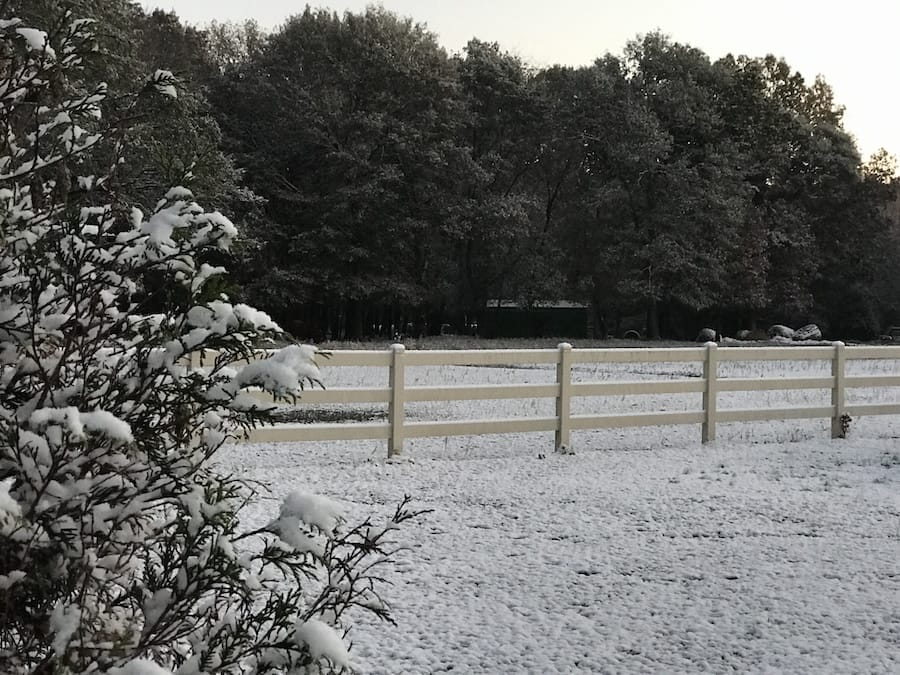
Snow doesn’t form because it’s cold where you’re standing. It forms way up in the clouds.
For snow to develop, the air high in the atmosphere has to be cold enough for moisture to freeze into ice crystals. If that happens and the air stays cold all the way down to the ground, those ice crystals fall as snow. Simple enough.
But here’s where things get tricky in Arkansas. Even if snow is forming in the clouds, it might not stay snow on the way down. If the air between the clouds and the ground warms up, those snowflakes can melt before they ever reach your backyard. That’s why your weather app might say “snow,” but all you see outside is cold rain.
This is also why forecasters sometimes struggle to pin down exactly what we’ll get. A few degrees difference in air temperature can mean snow in one neighborhood and rain just a mile away.
Why Does Snow Sometimes Not Stick?
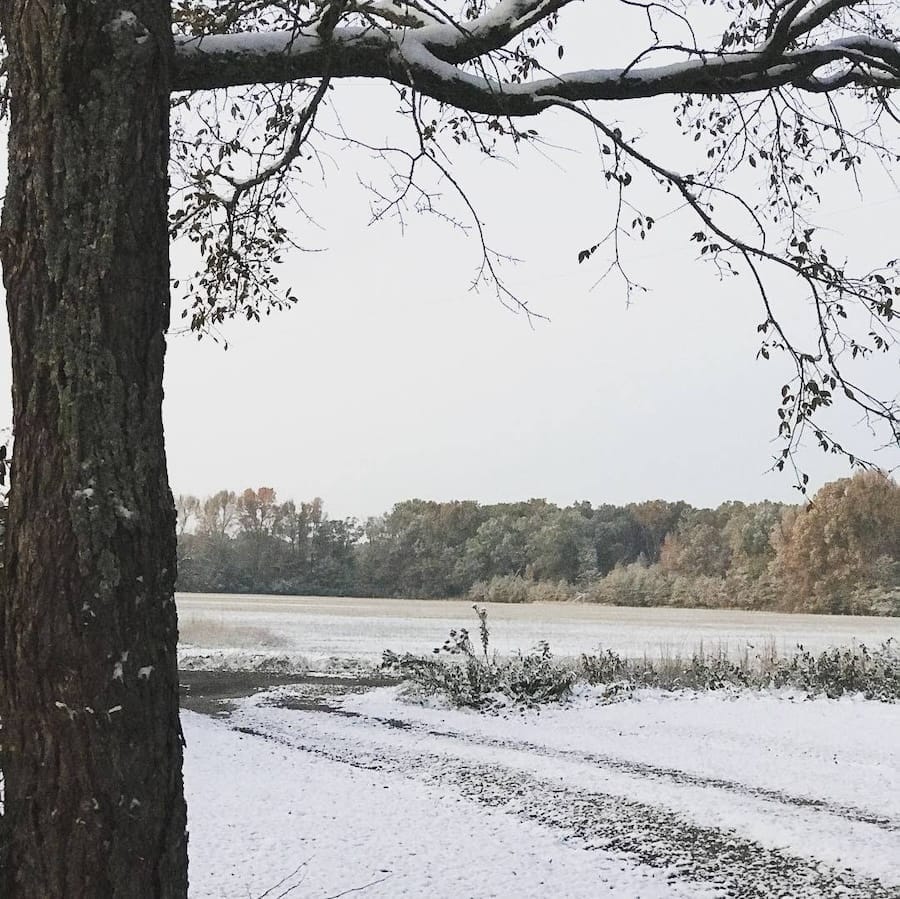
We’ve all seen it. Snow is falling, but the roads are just wet. Or it covers the grass but not the driveway.
That comes down to surface temperature. For snow to stick, the ground has to be cold enough. If the pavement has been warmed by sunshine earlier in the day or by days of mild temperatures, snow will melt as soon as it hits.
This is also why bridges and overpasses freeze before roads. They’re exposed to cold air above and below, so they cool down faster. That’s why those spots can be slick even when everything else looks fine.
Snow vs. Sleet vs. Freezing Rain
This is where winter weather gets annoying.
All three start the same way as snow falls from the clouds. The difference is what happens on the way down.
Snow stays snow when the air stays cold from top to bottom.
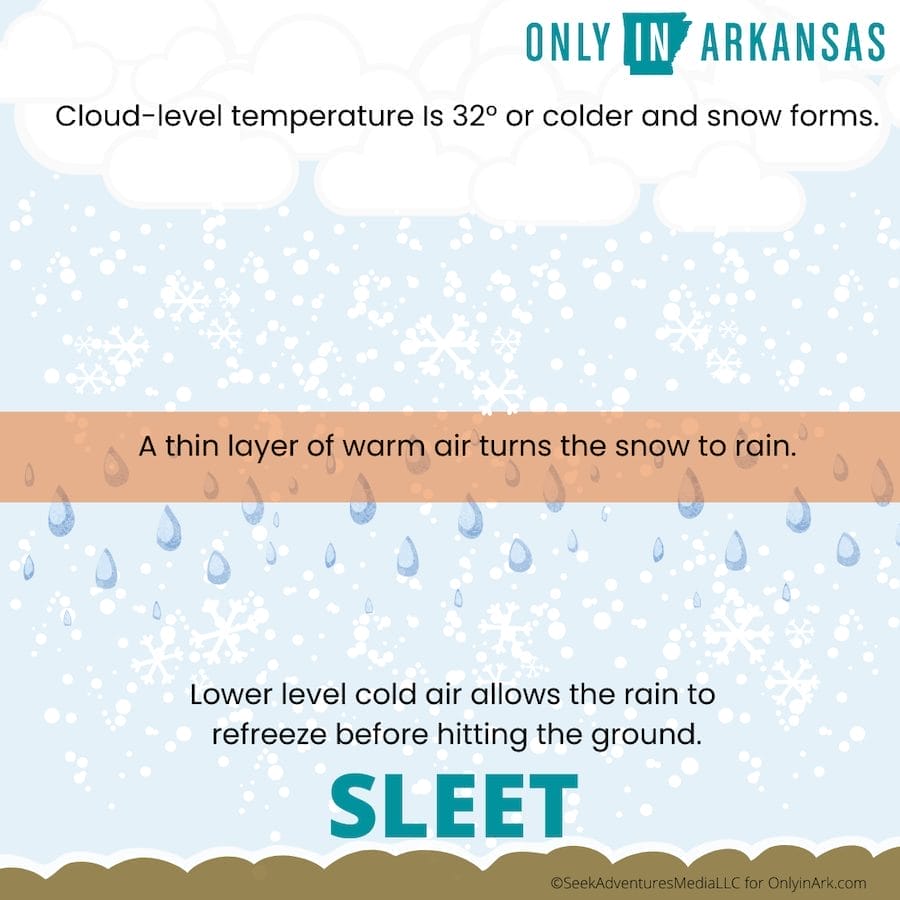
Sleet happens when snow partially melts as it falls through a warmer layer of air, then refreezes before it reaches the ground. What you end up with are tiny ice pellets that bounce when they hit the ground. Sleet can pile up and make roads slick, but it doesn’t usually coat everything in ice.
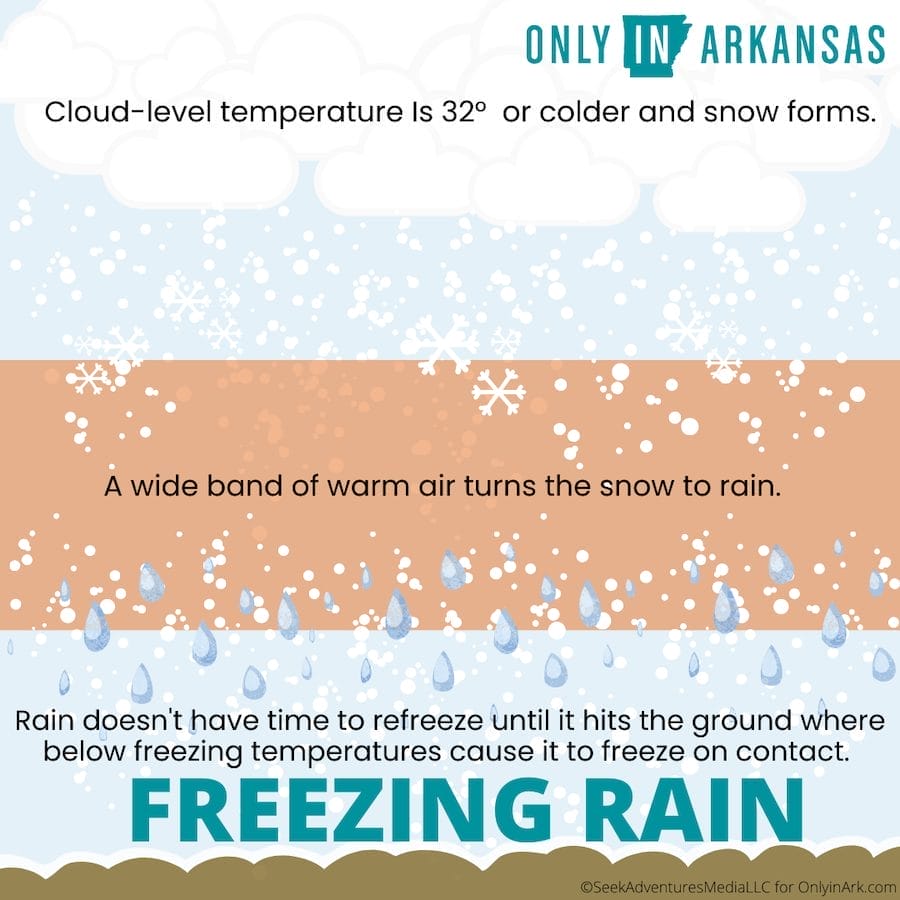
Freezing rain is the real troublemaker. Snow forms in the clouds but melts into rain as it falls through warmer air. When the rain reaches the ground where temperatures are below freezing, it freezes on contact, creating a smooth layer of ice on roads, trees, power lines and pretty much everything else.
If you’ve ever woken up to tree branches sagging under ice or lost power after a winter storm, freezing rain was likely the culprit. It’s far more dangerous than snow and one of the main reasons winter weather causes so many problems in Arkansas.
When Is It Actually a Blizzard?
People love to call any big snowstorm a blizzard, but the word has a specific meaning.
A blizzard isn’t about how much snow falls. It’s about wind and visibility. To officially be a blizzard, strong winds have to blow falling or already fallen snow around so much that you can barely see, and that has to last for several hours.
By that definition, true blizzards are extremely rare in Arkansas. We might get a heavy snow from time to time, but we usually don’t get the sustained high winds and whiteout conditions needed to call it a blizzard. So most Arkansas snowstorms are just that. Snowstorms.

How Arkansas Handles Winter Weather
Here’s the reality. Arkansas doesn’t get winter weather often enough to be equipped like northern states. The Arkansas Department of Transportation does prepare for winter storms, but on a smaller scale because it doesn’t make sense to have a massive fleet of snowplows sitting around unused most of the year.
Before a storm, ARDOT monitors forecasts closely and may treat major highways with a salt brine solution to help prevent ice from bonding to the pavement. During storms, crews focus first on interstates and major highways. Many smaller roads may not be treated at all and may be left to melt on their own as time passes.
After the storm, crews continue clearing and treating roads as needed, but winter weather here often resolves itself faster than up north. In most cases temperatures warm back up fairly quickly. It’s not uncommon in Arkansas to have a snowstorm immediately followed by unseasonably warm temperatures.
Because of these limitations, the best advice during winter weather in Arkansas is simple. If you don’t need to be on the roads, stay home. Even small amounts of snow or ice can create dangerous driving conditions, especially for drivers who don’t have much experience with winter travel.
If you do have to drive, slow down, leave plenty of space between vehicles, and be extra cautious on bridges and shaded areas where ice lingers longer.
A Few Winter Weather Fun Facts
- Most rain actually starts as snow high in the clouds, even in warmer months. The snowflakes just melt before reaching the ground.
- When you can see your breath on a cold day, you’re seeing moisture from your lungs turning into tiny water droplets in the cold air.
- Despite all our technology, snowfall is still measured the old-fashioned way. With a ruler. Several measurements are taken and averaged to get an accurate total.
Snow in Arkansas is rare enough that it still feels special. Sometimes it’s beautiful. Sometimes it’s frustrating. Often it’s confusing. But understanding a little of the science of snow makes those winter forecasts easier to follow and helps explain why Arkansas winter weather rarely looks like winter up north.
Whether it’s snow that melts by noon or ice that keeps everyone home for days, winter in the Natural State always keeps us guessing. And honestly, that unpredictability is part of the charm.
Check out these 10 Ways to Survive an Arkansas Snow Storm so you are prepared next time a winter storm hits.


We do the work.
You check your email.
Sign up for our weekly e-news.
Get stories sent straight to your inbox!


Like this story? Read more from Julie Kohl
After years of camping all over Arkansas, in tents, in RVs, in the...
Long before Hot Springs, Arkansas, became a national destination for...
The stories that tell Arkansas’s history often center around explorers,...
Join the Conversation
Leave a Comment