






Uh oh...
It appears that you're using a severely outdated version of Safari on Windows. Many features won't work correctly, and functionality can't be guaranteed. Please try viewing this website in Edge, Mozilla, Chrome, or another modern browser. Sorry for any inconvenience this may have caused!
Read More about this safari issue.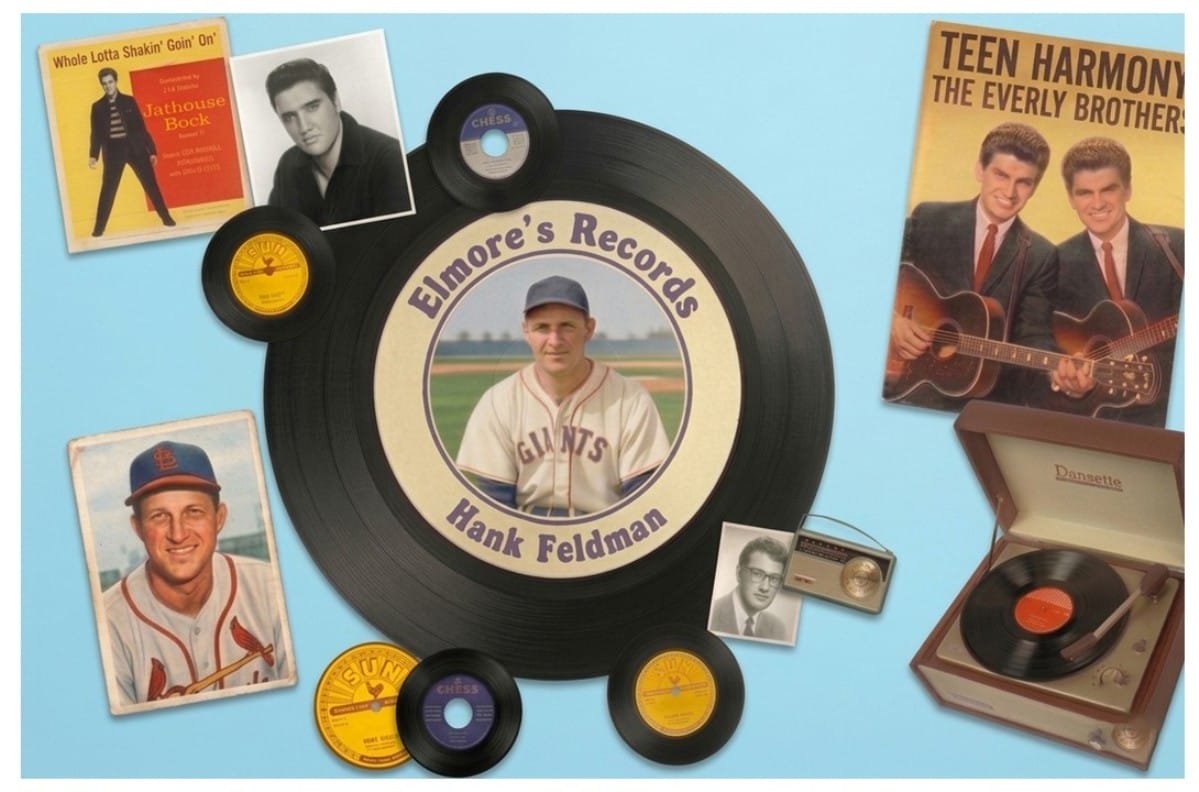

If you grew up in the 1950s, you are a member of the transistor radio generation. I received mine for Christmas in 1959. It was about the size of a bar of soap and came with a spiffy leather case. My gift brought Rock and Roll and the St. Louis Cardinals to my rural Ozark Mountain home.
I would listen to Harry Carey and the Cardinals on Fort Smith radio station KWHN for day games and regional station KMOX in St. Louis after sundown. I was eleven years old, and Dion and Stan Musial were my guys until I claimed the New York Yankees as my team in high school and moved on to the Beatles.
When my dad sold our calves at the Fort Smith stockyards, I tagged along. After all the business was done, we drove down bustling Garrison Avenue. It looked a lot like my vision of Disneyland.
About halfway down the busy main street was a store called Elmore’s Records, where I could choose a 45-rpm record, maybe two, if the calves sold well. I liked the music, and I loved baseball. I never knew that Hank Feldman, the owner of Elmore’s Records, was a former big-league baseball player. That knowledge would have elevated his celebrity status to a level somewhere between the Everly Brothers and Elvis.

Harry Feldman was 18 years old when he approached New York Giants manager Bill Terry at a tryout in New York City. He was getting impatient for some attention in a horde of aspirants who had shown up at the Giants’ annual gathering of young men with big-league dreams. Young Harry had his story ready when he finally got his chance to speak to the manager. “I work in a shirt factory for 13 cents an hour; make me a better offer.”
The introduction must have worked. The Giants offered Feldman a contract after the tryout, and the young man from the Bronx jumped at the chance without fear of the culturally foreign land where he might be assigned.
After about a month of practice and evaluation in spring training in Louisiana, the minor league prospects received their assignments. Two groups of younger prospects were headed for Arkansas, a Class C group to Fort Smith and a Class D squad to Blytheville in the Northeast Arkansas League. Harry Feldman and several other big-city rookies were bound for Blytheville.
If the urban youngsters assigned to Blytheville were suffering from culture shock, they did not show it on the field. The 1938 Blytheville Giants dominated the Northeast Arkansas League, and Hank Feldman was the ace of the staff. He had won 13 and lost 1 before his promotion to Fort Smith on July 11. Feldman added seven more pitching wins in Fort Smith. For the two teams, his record was 20–8 with a combined ERA of 2.80.
Reassigned to the Fort Smith version of the Giants again in 1939, Feldman was instrumental in another pennant-winning season. He led the team in every major pitching category. Working in 40 games, Feldman pitched 276 innings, winning 25 games and losing 9.
While a member of the Fort Smith Giants, 19-year-old Feldman met a local teenager who was destined to be his wife. He and Lauretta Myatt would marry before the 1941 season, and Fort Smith, Arkansas, would be the Feldmans’ hometown for the rest of their lives.

Hank Feldman was on the fast track to the big leagues. After two more summers in the Giants’ minor league system and a brief major league trial in late 1941, he opened the 1942 season on the New York Giants opening day roster.
A battle with tuberculosis interrupted the early months of Feldman’s rookie year. He did not become a member of the Giants’ starting rotation until July. Getting stronger as the season entered its final month, he won his last five decisions. Although Feldman finished the season pitching well, the Giants finished a distant third.
Over the next three years, the Giants never finished higher than fifth, and although Feldman had a losing record each season, his record was deceiving. He pitched more than 200 innings in 1944 and 1945. He won 12 and lost 13 in 1945, pitched 3 shutouts, and had 10 complete games in 30 starts for a team that offered very little run support.
The 1946 season was a turning point in Hank Feldman’s life. Since joining the Giants in 1941, he had been a mainstay of their pitching staff; however, as many major league players returned from military service, his past performances did not secure him a spot for the 1946 season.

Feldman began the 1946 season on something called the “Ailing List,” and he did not get off to a good start. He pitched a total of four innings in April, losing two pitching decisions and recording an ERA of 18.00. Unwilling to accept the inevitable demotion of a minor league assignment, Feldman joined dozens of major leaguers who accepted lucrative offers in the Mexican League.
Despite the increased number of players now available, the owners expected the commissioner to defend their “property.” With public opinion on his side and big-league owners unanimously in his corner, Baseball Commissioner Happy Chandler announced a five-year suspension for those players who had defected to the Mexican League. Among those banned was Harry Feldman.
Although he was only 26 years old, Feldman was not the effective starting pitcher in the Mexican League that he had been in New York. Was there more to the “ailing list” story, or had the 400+ innings over the last two seasons taken a toll on the iron man of the Giants’ staff? Regardless of the contributing factors, Hank Feldman’s career in major league baseball was over.
The results of his defection were not all negative for Feldman. The $15,000 bonus he received in his first year in Mexico allowed him to buy a home in his adopted hometown. Major League Baseball ostracized him for signing with the Mexican League, but Fort Smith, Arkansas, permanently welcomed one of its most beloved adopted sons.

By 1949, most of the major leaguers who were playing in the Mexican League had returned home. Commissioner Happy Chandler’s support for the suspensions had deteriorated. Baseball fans had long since forgiven the players, and public opinion led the commissioner to end the expulsion.
Some former big-leaguers returned to the major leagues, but it was too late for Harry Feldman. He was able to find a job for the 1949 and 1950 seasons, pitching for San Francisco in the Pacific Coast League. In 1950, his final professional season, he worked 230 innings and pitched in a team-high 46 games. The next year, too old for a big-league promotion, Feldman became a year-round citizen of his favorite city, Fort Smith, Arkansas.
Looking for a business in his chosen hometown, Feldman fortuitously bought a record store. In the early 1950s, during the music boom brought on by the arrival of Rock and Roll, Elmore’s Records became a teenage hangout, and Feldman became a successful businessman.

Feldman also became a community advocate for summer baseball and a leader in establishing a youth league appropriately named the Hank Feldman League. Feldman died on March 16, 1962, while on a fishing trip to Oklahoma. He was 42 years old. Each year, the league awards the Hank Feldman Award to a youngster who exemplifies the sportsmanship and character exemplified by the league’s namesake.
Personal Note: In the summer of 1963, my Ozark Babe Ruth League team was runner-up in the Hank Feldman postseason tournament.
Photos courtesy of Libby Brodie and The Jewish Baseball Hall of Fame.


We do the work.
You check your email.
Sign up for our weekly e-news.
Get stories sent straight to your inbox!

Like this story? Read more from Jim Yeager
Nicknames are an integral part of professional baseball culture and one...
In the spring of 1979, baseball at the University of Arkansas was far...
The Arkansas Travelers closed their 2006 season on September 3, with a...
Join the Conversation
Leave a Comment