





Uh oh...
It appears that you're using a severely outdated version of Safari on Windows. Many features won't work correctly, and functionality can't be guaranteed. Please try viewing this website in Edge, Mozilla, Chrome, or another modern browser. Sorry for any inconvenience this may have caused!
Read More about this safari issue.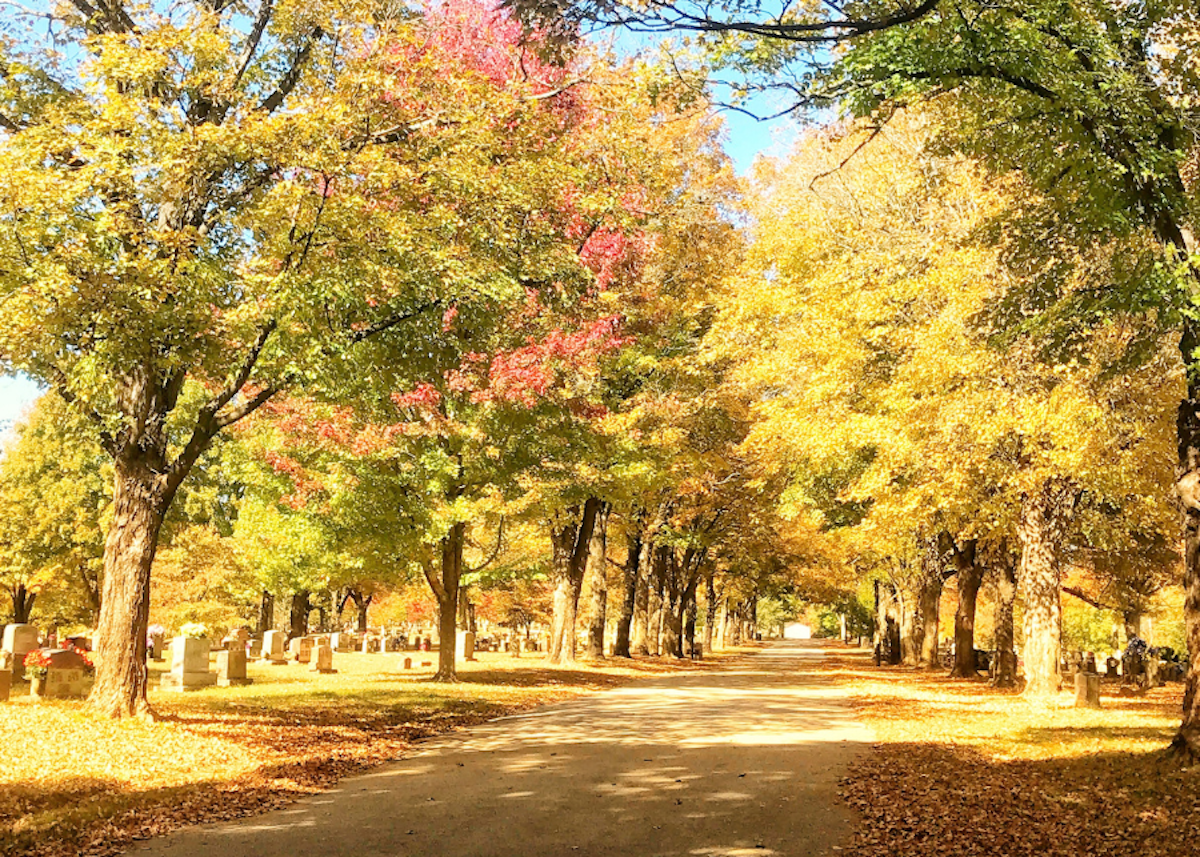

Since I was a teenager, something about the cool weather and falling autumn leaves has made me want to wander through an old cemetery. Maybe some deep inner clock recognizes more than the change of seasons. Autumn reminds us that time is passing and human life is fragile. An old cemetery makes that hard to ignore.
Over the years, I’ve learned to look beyond just the names and dates of those who lived and died. The shape of a marker, the style of the lettering, and the small details carved into the stone can tell you something about the person buried there and the time they lived in. Sometimes even the person who carved the stone left a mark, and in cemeteries across the Arkansas Ozarks, one name shows up again and again. Nick Miller was a stone carver who worked across northern Arkansas in the late 1800s.
The Work of Nick Miller
Not much is known about Nick Miller’s early life. He was born in Germany around 1846 and first appears in Arkansas records in Bentonville in 1872, when he became a U.S. citizen. By 1877, he was advertising his stone carving work and a marble yard in Hindsville.
Over the next two decades, Miller moved frequently, working in Bentonville, Berryville, the Boone and Newton County area, Yellville and Harrison. Moving around wasn’t unusual for a stone carver at the time. A craftsman might stay long enough to fill local orders before moving somewhere with more work or better access to stone.
Miller advertised imported marble but also worked with Arkansas stone. In 1883, he moved to Wilcockson, the Newton County community near Jasper that was later known as Marble Falls (Dogpatch USA). Here Miller had access to a nearby limestone quarry. The Early Mississippian limestone was often called “Arkansas Marble.” Decades earlier, a 9,000-pound limestone block from the same quarry had been selected as Arkansas’s contribution to the Washington Monument.
Reading a Victorian Gravestone
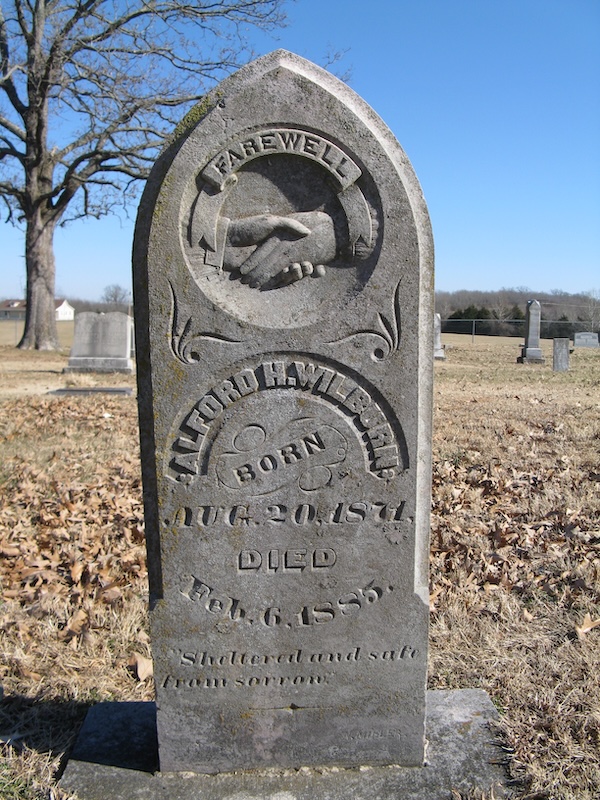
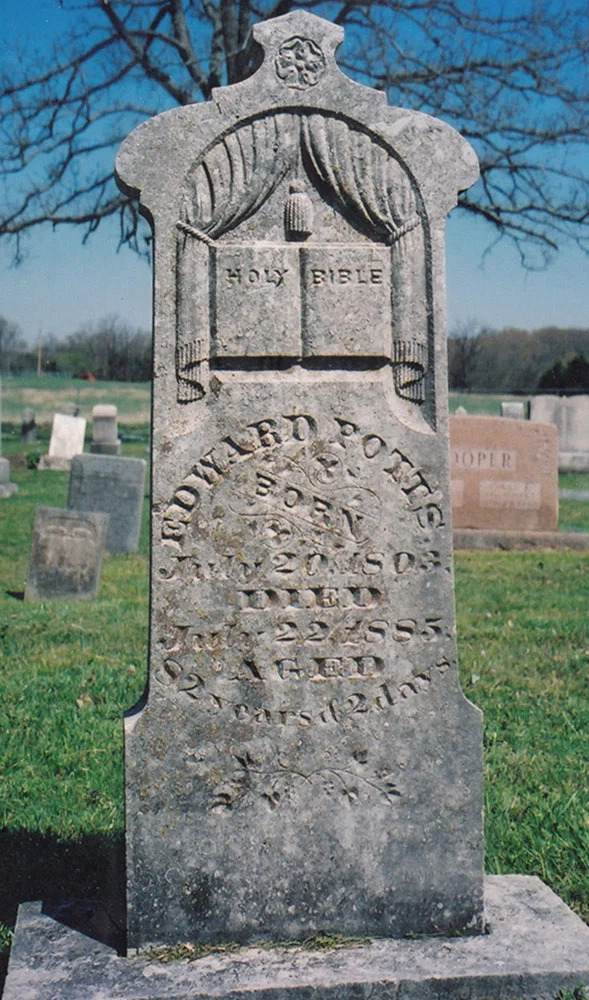
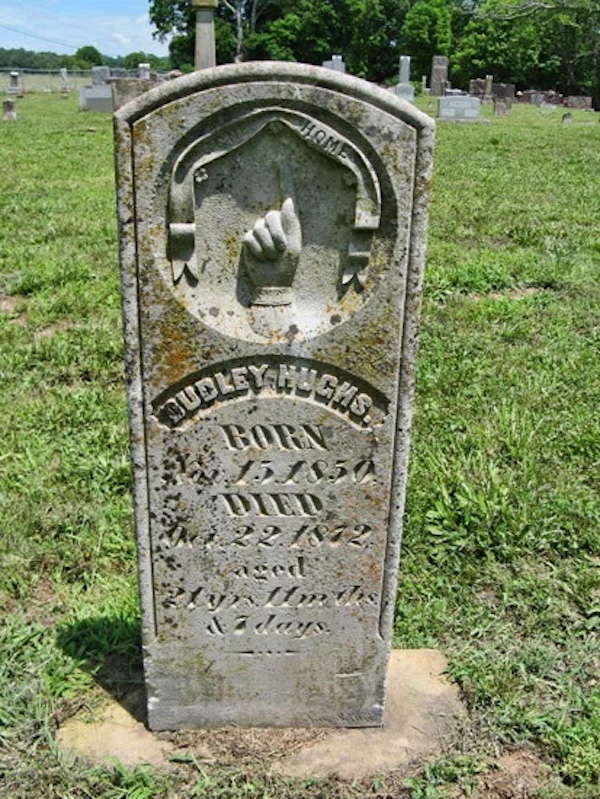
Victorian gravestones weren’t carved with names and dates alone. Miller also carved symbols that were common to the period. A weeping willow was associated with grief and mourning, while clasped hands could suggest farewell, a bond between loved ones or the hope of meeting again. Lambs represented innocence and Christian faith and frequently appeared on children’s graves. Doves could represent purity, faith or the soul entering eternal life. The meaning could vary by family and design, but these carvings offer another way to understand how people in the late 1800s expressed grief and remembrance.
Miller often carved his decorative designs in bas-relief, a technique in which the background is cut away so the image remains slightly raised above the stone’s surface. He also cut his lettering unusually deep. Weather and the type of stone certainly affect how well a gravestone ages, but deeper letters can withstand more surface erosion before they become difficult to read. That may be one reason many of Miller’s inscriptions remain surprisingly clear more than a century later.
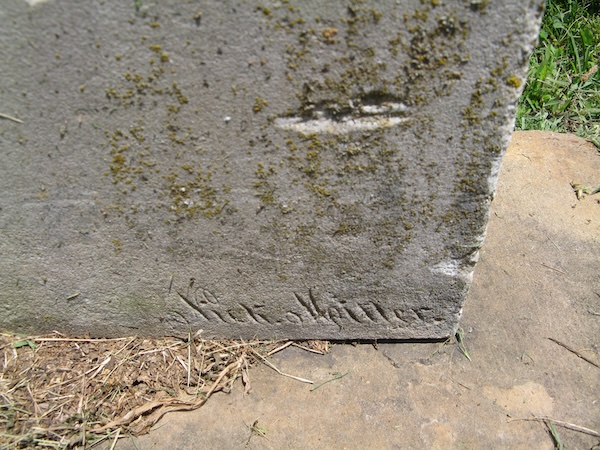
Miller also signed his work and encouraged the men he trained to do the same. Look near the bottom of one of his markers, and you may find “Nick Miller,” “N. Miller” or simply “N. M.” Those small signatures have helped cemetery historians identify his work and trace the path of a stone carver who worked across the Arkansas Ozarks. His students included Thomas E. Mitchell, A. C. Key, and brothers William and John Rance Jones, whose signatures also appear on gravestones throughout the Ozarks.
Gravestones weren’t Miller’s only work. He carved building and chimney stone, foundations, mantels and tabletops. During a building boom in Yellville in the late 1880s, he worked on foundations and architectural stone around town. A November 1889 issue of Yellville’s Mountain Echo even reported that “Nick Miller is doing some of the stone lettering for the Yellville bank.”
Where to Find Nick Miller’s Gravestones
Miller’s work has been documented across the Arkansas Ozarks. Signed stones have been found in Benton, Madison, Carroll, Boone, Newton, Washington and Johnson counties, as well as extreme southern Missouri.
A few that contain well-documented examples include:
- Wesley Cemetery, Madison County
- Western Grove Cemetery, Newton County
- Loback Cemetery, Boone County
- Berryville Memorial Park/City Cemetery, Carroll County
There are likely others scattered throughout the region. When visiting an older cemetery, check near the base of tablet-style markers for the telltale signature markers. Remember that these are historic burial places, so don’t rub, chalk, clean or otherwise alter a marker to make a carving easier to see.
The Carver Without a Stone
Some people plan well in advance for how their grave will be marked. Nick Miller made arrangements for his burial, but apparently a gravestone wasn’t part of the plan.
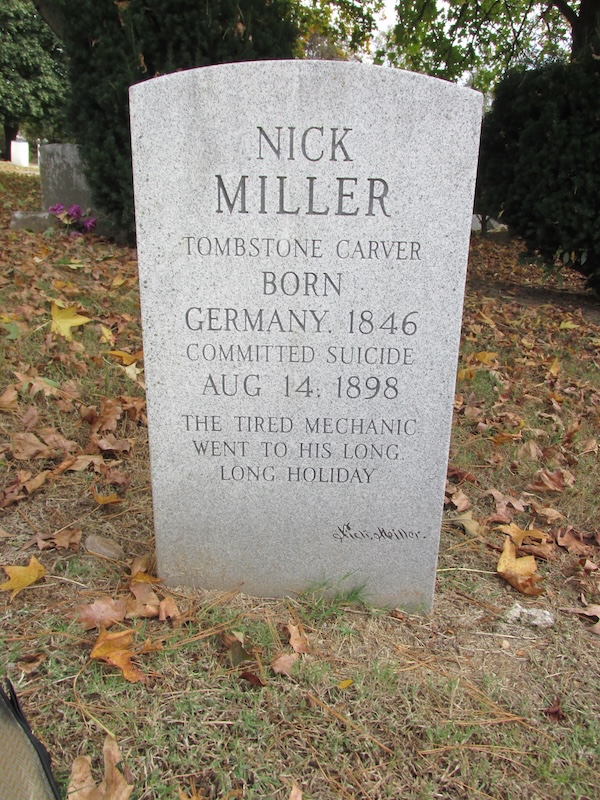
Miller returned to Berryville in 1893. On Aug. 14, 1898, at about 52 years old, he died by suicide after taking cyanide. Before his death, he left instructions suggesting that his stone, tools and photographs be sold to the Jones brothers, two of the carvers he had helped train, to help pay for his coffin. He was buried in Berryville’s city cemetery without a marker.
After more than 100 years, a local historical society added a marker to his grave, including the epitaph “The tired mechanic went to his long long holiday,” which was requested in his suicide note. It also contains a copy of his signature.
His own grave may not be part of his legacy, but his work certainly is. Many examples remain scattered through cemeteries across the Arkansas Ozarks, still carrying the names, symbols and small signatures he carved into them more than a century ago.
Cover photo by Julie Kohl. All other photos courtesy of Abby Burnett.


We do the work.
You check your email.
Sign up for our weekly e-news.
Get stories sent straight to your inbox!


Like this story? Read more from Julie Kohl
The teacher in me is always looking for ways to sneak a little learning...
Walk through almost any old cemetery in Arkansas and it is easy to focus...
Tennessee and Mississippi get most of the attention when people talk...
Join the Conversation
Leave a Comment