





Uh oh...
It appears that you're using a severely outdated version of Safari on Windows. Many features won't work correctly, and functionality can't be guaranteed. Please try viewing this website in Edge, Mozilla, Chrome, or another modern browser. Sorry for any inconvenience this may have caused!
Read More about this safari issue.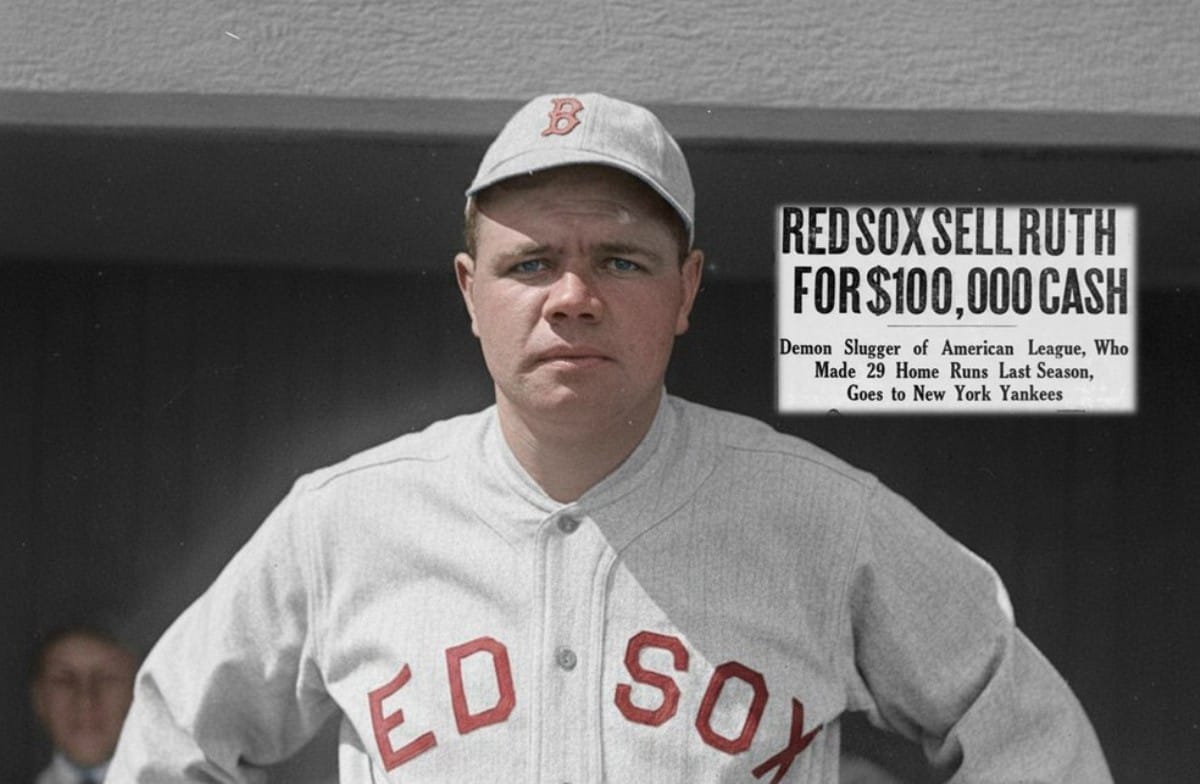

In 1920, the winter days between Christmas and New Year’s Day promised to be one of the quietest sports weeks of the year. The birth of the NFL was two years away, and the NBA would not be part of the Christmas Week schedule for more than 25 years. Baseball was the only professional sport that garnered any national attention. Spring training was two months away.
Contrary to the expectations for a slow sports page week, on December 26, 1920, a day that should have been a sportswriter’s day off, the New York Yankees and Boston Red Sox produced one of the most historically significant events in American sports history. The deal would change the game forever and create an enduring enmity between two of America’s premier baseball cities, which continues to this day.
There are a lot of points of light in baseball history, never one brighter than this.
–Best-selling author Mike Lupica
On that sports-devoid day after Christmas 105 years ago, Boston owner Harry Frazee agreed to sell his problematic star, Babe Ruth, to the New York Yankees for $100,000 and a loan. In hindsight, the trade not only sent the colorful “Big Fellow” to the Yankees, where he would become the most recognizable name in the history of the game, but it also spawned American baseball fans’ affection for the home run.
A thousand miles from New York, baseball fans in Hot Springs, Arkansas, were paying close attention to the headlines that began to appear the next week. The resort town in the Ouachita Mountains had become a spring training destination for many big-league baseball teams and individual stars. The most popular of the spring visitors was a young Red Sox pitcher/outfielder named George Herman Ruth. The Spa City loved the Babe and the feeling was mutual.
Babe Finds His Happy Place
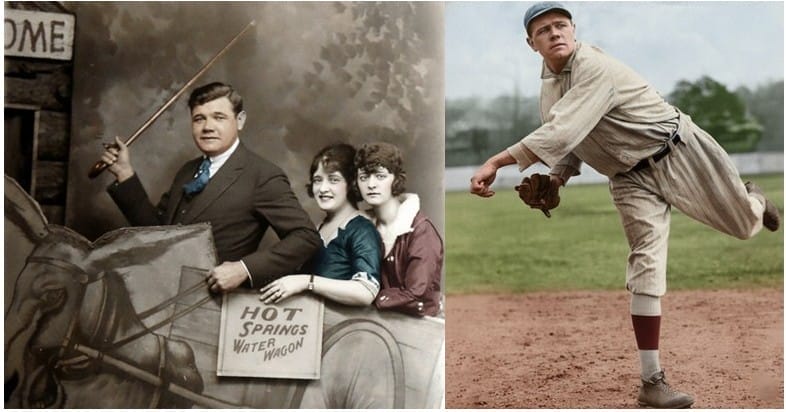
When Babe Ruth arrived in Hot Springs, Arkansas, in March of 1915 as an unsophisticated street kid from a Baltimore orphanage, he must have thought he was in a baseball wonderland. A town with tree-lined mountain trails, warm baths and fancy hotels was beyond anything he had ever experienced. Along with the amenities he never imagined, his spring training hometown had good food, a raucous nightlife, and baseball. Hot Springs baseball historians, Mike Dugan, Bill Jenkinson, and Don Duren described the Babe Ruth that first arrived in Hot Springs as a “6-foot-2-inch, rock-hard, 200-pound juggernaut who hit the ball harder, pitched better, hiked with more stamina, and ate more food than anyone in town.”
The Babe Ruth, who came with the Red Sox in 1915, was a 20-year-old pitcher. From 1915 to 1918, he pitched more than 1,000 innings and won 78 games. Both totals were tops among Boston pitchers for that period. He only played occasionally on days when he did not pitch, but his .300-plus batting average and home run power never convinced the Red Sox that he had a future as an everyday player.
In Hot Springs, with a shortage of players in big-league baseball due to World War I, Babe played every day and his hitting became the talk of the town. Ruth became a frequent visitor to the golf courses, restaurants, and gambling halls around town, and he was the most watched player in the spring training games.
Spring 1918, Home Runs and Alligator Farms
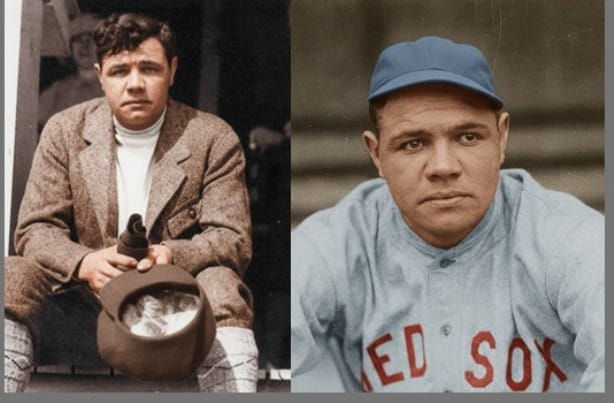
Although Babe Ruth, the pitcher, had led the Red Sox in pitching victories, innings pitched and completed games in 1917, it was his hitting that made headlines at spring training in 1918. Each year, Babe had played more games on days he did not pitch, and the Red Sox were reluctantly planning even more outfield time for their ace pitcher in 1918.
Baseball in 1918 was a singles and doubles base-to-base game. Trying to hit home runs led to strikeouts, and baseball leaders disapproved of such wild swinging. Owners assumed that fans loved the strategy of the time. The Red Sox’s cross-town rivals, the Boston Braves, went so far as to build a new ballpark with an impossible-to-reach center field fence. The reasoning was that fans enjoyed triples more than home runs.
Babe Ruth began to change that erroneous theory in Hot Springs, Arkansas, in the spring of 1918. The Babe did strike out often by the standards of the day, but he also hit prodigious towering drives over fences and into the streets of the Spa City. The soon-to-be christened “Great Bambino” was changing baseball from a resort town in Arkansas.
The two most talked about and debated Ruth home runs from that spring occurred on March 17 and March 24, at Whittington Park, one of the city’s most popular spring training venues. A historical marker at the baseball park’s original location marks the spot where Ruth hit a legendary homer over the outfield fence, across Whittington Avenue, and into the Alligator Farm 573 feet from home plate.

Babe Ruth scholar Bill Jenkinson and his colleagues have spent hours researching the accuracy of those historic home runs. Jenkinson’s conclusions: The second home run on March 24 was the longest of the two storied homers. Jenkinson’s work concluded that although the exact distance will never be known, the evidence that Babe Ruth hit the first authenticated 500 ft. home run is “irrefutable.” The historians who spent years researching these legendary home runs called the spring of 1918, The Home Runs That Changed Everything.
In the third inning (3-24-1918), he smashed another tremendous home run to right-center field, a grand slam that cleared a pond just to the right of the same Alligator Farm. Stunning the crowd, Babe had launched this drive even farther than the second St. Patrick’s Day blast. Without question, it flew well over 500 feet. –Bill Jenkinson
1925 The Party is Over – “The Bellyache Heard ‘Round the World.”

Babe Ruth’s arrival made the Yankees better immediately, but Babe needed some help. The Yanks finished third in the American League in 1920. Ruth hit 54 home runs. Ruth’s teammate, Aaron Ward from Booneville, Arkansas, was seventh in the American League with 11 home runs. The Yankees drew 1,289,422 to the Polo Grounds they shared with the Giants. The National League Giants drew fewer than a million. Although baseball was a team sport, Babe Ruth was the game’s most popular attraction.
In 1923, the Yankees moved into their new ballpark. In the movie-script season, Ward got the first hit by a Yankee in the new stadium, Ruth hit the first home run, and the Yanks won their first World Series with the Great Bambino in the lineup.
The Yanks continued to return to Hot Springs each spring and The Babe became a tourist attraction on the baseball field and out on the town. Although the Yankees fell to third in the American League in 1924, Ruth led the league in hits, runs scored, batting average, and, of course, home runs. The spring of 1925 would be Babe Ruth’s last spring training in Hot Springs.

Babe arrived in Hot Springs in February 1925 for his personal routine: some moderate walking, golf, gambling and overeating. By the time he left Arkansas to join his teammates, he had experienced flu-like episodes and his weight had reached 270 lbs. On April 7, he was hospitalized in serious condition with an intestinal situation so serious that some news outlets announced his death. Babe did not return to the Yankees until June. He played in fewer than 100 games, hit only 25 homers, and batted under .300 for the first time as a Yankee. The Yanks fell to seventh place.
The Yankees’ leadership placed some of the blame for Ruth’s physical condition on his adventures in Hot Springs. Ruth recovered, but his very un-Ruth-like year led the Yanks to forbid Babe’s personal spring training in Arkansas. Babe Ruth would lead the Yanks to three more World Series Championships, but his carefree days in his beloved spring retreat were over.
The Adventures of Babe Ruth live on in Hot Springs
Hot Springs Baseball Trail
Majestic Park
Dugan Invitational College Baseball Tournament
Hot Springs Baseball Weekend
A Long Weekend in Hot Springs


Like this story? Read more from Jim Yeager
 0
0
1942 | A “Green Light” and a Pennant for the Travelers

In 1942, the Americans Tom Brokaw would later celebrate as our...
 1
1
The Little Rock Travelers Miracle of 1951
The 1951 baseball season arrived in Little Rock with little cause for...
 1
1
The Lost Story of Arkansas’s Pat Seerey
In 1994, Hall of Famer Ted Williams was contracted to create his personal...
Join the Conversation
Leave a Comment
One response to “Babe Ruth in Hot Springs”
 Leave a Reply
 Leave a Reply
We do the work.
You check your email.
Sign up for our weekly e-news.
Get stories sent straight to your inbox!

“In Hot Springs, with a shortage of players in big-league baseball due to World War II …”
World War I
Appreciate the story.