It appears that you're using a severely outdated version of Safari on Windows. Many features won't work correctly, and functionality can't be guaranteed. Please try viewing this website in Edge, Mozilla, Chrome, or another modern browser. Sorry for any inconvenience this may have caused!
As I planned a road trip through the Arkansas Delta last year, I found myself preparing in several ways. I did online research, used trip-planning websites like this one, read books about the Delta and the people who grew up there, queued up a few podcasts about the region, and watched a handful of movies set in the landscape.
One of those movies was “A Painted House,” based on the semi-autobiographical novel by Arkansas native John Grisham. Along with the Arkansas-set film “Mud,” it quickly became one of those quintessential Delta stories that capture the rhythms of rural life.
I listened to the audiobook of A Painted House years ago, but watching the movie again reminded me how deeply Grisham’s storytelling is rooted in the American South. His stories often take readers into courtrooms and high-stakes legal drama, but beneath those plots are deeper themes of family, justice, and the complex histories of Southern communities.
Official headshot for print from John Grisham’s team.
Who is John Grisham?
John Ray Grisham Jr. was born February 8, 1955, in Jonesboro, Arkansas. His parents were involved in agriculture in northeast Arkansas, helping family members on a cotton farm near Black Oak. Although the family eventually moved to Mississippi, Grisham spent summers in Arkansas with relatives and kept strong ties to the region.
Those early experiences in rural communities shaped many of the themes that would later be reflected in his writing.
Grisham grew up in a working-class family. His father worked in construction and farming, while his mother encouraged her children to read and value education. Books were a common part of family life, and Grisham often remembers getting a library card every time the family moved to a new town, right after they joined the First Baptist Church.
Despite that encouragement, writing was not always an easy path. In fact, Grisham once failed English in community college.
However, his passion for storytelling gradually grew, especially after a high school teacher introduced him to writers like John Steinbeck, who left a lasting impression and helped shape his approach to writing about rural people and real struggles.
Today, Grisham is among the world’s most successful authors. He has written dozens of novels, sold over 300 million books worldwide, and had a string of bestselling titles.
How Did He Become an Author?
Grisham’s path to writing success was far from direct.
He attended several colleges before graduating from Mississippi State University with a degree in accounting. Four years later, he earned a law degree from the University of Mississippi and started practicing tax law, but eventually specialized in civil litigation.
While working as a lawyer, Grisham often found inspiration in the courtroom. One specific case he observed, where a young victim told her story before a jury, sparked the ideas that would eventually become his first novel.
That book, “A Time to Kill,” took three years to write. Grisham established a strict routine, waking up early and writing from 5 to 7 a.m. before heading to his law office. But even after completing the manuscript, success didn’t come quickly.
The book was rejected by 28 publishers before finally being accepted by a small press, which agreed to publish an initial print run of only 5,000 copies.
The real breakthrough happened with his second novel, “The Firm,” published in 1991. It became an international bestseller and stayed on The New York Times bestseller list for 47 weeks. After that, Grisham’s career accelerated greatly, especially as his books were adapted into movies and the courtroom thrillers grew in popularity.
“A Painted House,” a semiautobiographical novel base don Grisham’s life in Arkansas, was written 25 years ago.
What Does John Grisham Write About?
John Grisham is best known for his legal thrillers that blend courtroom drama, political intrigue and high-stakes justice.
Many of his books are set in the fictional town of Clanton, Mississippi, which is in the imagined Ford County. These stories often examine social tensions in Southern communities, such as race, power, and the complexities of the legal system.
Over time, Grisham broadened his storytelling beyond legal thrillers. A major change came with A Painted House, a novel inspired by his childhood memories of growing up around cotton farms in the Arkansas Delta. The story emphasizes family life, rural hardships, and the cultural landscape of the South instead of the courtroom.
The book was later adapted into a Hallmark TV movie, which was filmed in and around Lepanto, Arkansas. Today, the farmhouse set used during filming remains on display there.
Grisham has also written sports fiction, comedy, and a series of legal thrillers for young readers, the Theodore Boone series, which follows a young boy fascinated with the law. His book Boys from Biloxi was filmed at the historic Fort Chaffee.
Grisham Books You’ll Love
Part of the joy of reading John Grisham is being transported into vivid settings and compelling stories that are hard to put down, making them ideal Spring Break and summer reads.
My first encounter with Grisham was through the novel “Calico Joe.” I picked it up during my son’s first baseball season, and the story immediately resonated with me. Baseball, family, redemption, and America’s favorite pastime all came together in a powerful way.
It also reminded me how often Grisham’s stories carry subtle connections back to Arkansas.
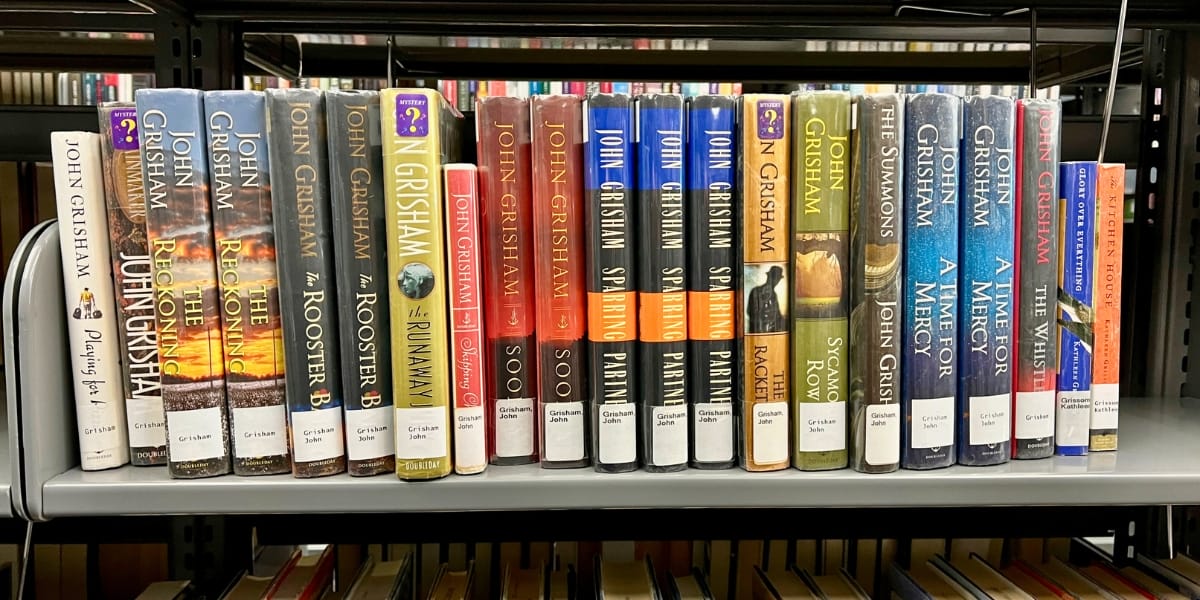
If you’re building a spring break reading list, here are a few titles worth adding to your stack.
The Camino Series, which includes “Camino Island,” “Camino Winds and “Camino Ghost,” combines art theft, mystery and coastal intrigue.
The Exchange – A recent thriller that continues Mitch McDeere’s story from “The Firm,” set during an international business trip that goes terribly wrong.
The Reckoning – An epic Southern story of war, justice and family secrets.
The Broker – If Europe has been on your mind, this global story shifts from Washington D.C. to Italy.
Start the Jake Brigance Series with “A Time to Kill,” then read “Sycamore Row” and “A Time for Mercy.” If you enjoy a good series, these courtroom dramas will keep you engaged without any breaks between books.
The Testament – An intense thriller that moves from Washington law firms to the remote jungles of Brazil.
Besides “Calico Joe,” most of these books aren’t exactly light beach reads, but they are incredibly engaging. They make you find extra errands just to keep listening to the audiobook, especially when narrated by Michael Beck.
Grisham has also dedicated time to writing nonfiction, particularly on wrongful convictions and criminal justice reform.
In Oct. 2024, he published “Framed: Astonishing True Stories of Wrongful Convictions,” co-authored with Jim McCloskey. The book explores real cases in which innocent people were imprisoned due to corruption, bias, or investigative errors within the justice system.
The project showcases Grisham’s enduring interest in the legal system beyond his fiction work and his position on the Innocence Project’s board.
Grisham maintains a disciplined writing routine, usually starting early in the morning and writing for several hours daily.
His recent novel, “The Widow,” released in late 2025, tells the story of an elderly woman seeking legal advice in a complex case involving family, wealth and betrayal. While the “who dun it” style story received mixed reviews, it remains another example of Grisham’s ability to draw readers into intricate legal and personal drama and weave in some of his Arkansas roots.
For Arkansas readers and travelers alike, John Grisham remains a captivating literary connection to the Delta landscape that influenced part of his early life. And if you find yourself traveling through northeast Arkansas, you can even visit Lepanto, where scenes from the television adaptation of “A Painted House” were filmed.
Keisha (Pittman) McKinney lives in Northwest Arkansas with her chicken man and break-dancing son. Keisha is passionate about connecting people and building community, seeking solutions to the everyday big and small things, and encouraging others through the mundane, hard, and typical that life often brings. She put her communications background to work as a former Non-profit Executive Director, college recruiter and fundraiser, small business trainer, and Digital Media Director at a large church in Northwest Arkansas. Now, she is using those experiences through McKinney Media Solutions and her blog @bigpittstop, which includes daily adventures, cooking escapades, #bigsisterchats, the social justice cases on her heart, and all that she is learning as a #boymom! Keisha loves to feed birds, read the stack on her nightstand, do dollar store crafts, cook recipes from her Pinterest boards, and chase everyday adventures on her Arkansas bucket list.











Like this story? Read more from Keisha Pittman McKinney
Paragould sits at the intersection of the Arkansas Delta and Crowley’s...
Something about the Ozark Mountains in autumn invites a touch of mystery....
Located along U.S. Highway 71, about eight miles north of Mountainburg,...
Join the Conversation
Leave a Comment