






Uh oh...
It appears that you're using a severely outdated version of Safari on Windows. Many features won't work correctly, and functionality can't be guaranteed. Please try viewing this website in Edge, Mozilla, Chrome, or another modern browser. Sorry for any inconvenience this may have caused!
Read More about this safari issue.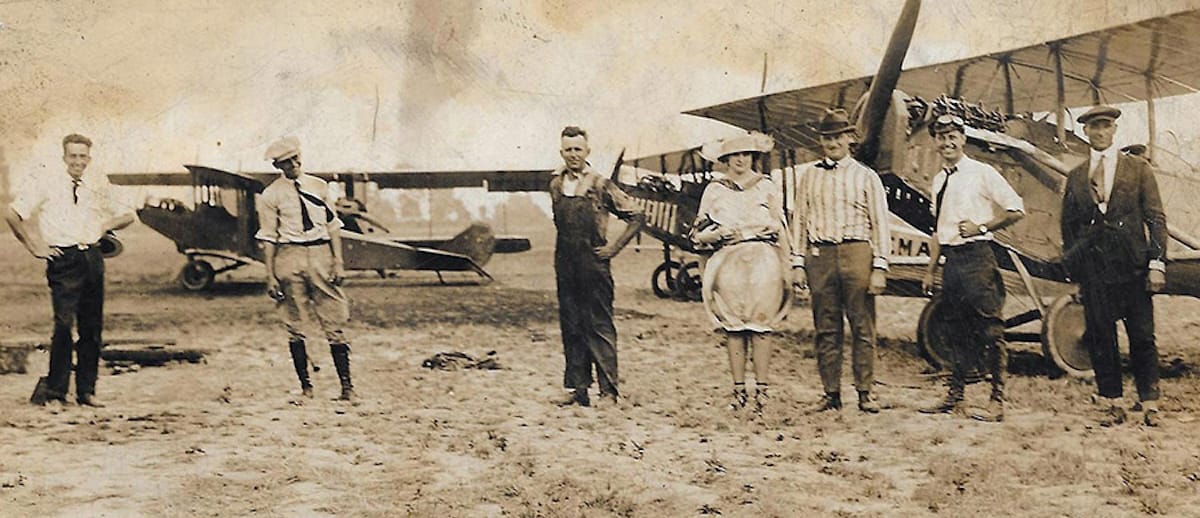

We’re living in a moment of rapid change. Artificial intelligence, robotics and automation are already reshaping the 21st century, and we’re watching it happen in real time. It’s easy to take for granted, but we’re standing at the edge of something new. In many ways, I imagine we feel like people did at the start of the 20th century. The telephone changed communication and the automobile and airplanes had a profound impact on transportation. It was new and exciting but also terrifying.
Today, flight feels routine, but there was a time when simply leaving the ground seemed extraordinary, if not impossible. In places like Stuttgart, Arkansas, that sense of possibility took hold early, and few embraced it more than Richard Schilberg, who saw in the wide, open prairie not just a place to land, but the potential for an aviation hub in the South.
In the early 1900s, Arkansas looked very different from what it does today. Much of the state, especially the Grand Prairie around Stuttgart, was rural and flat. Rice farming drew people to the Grand Prairie, transforming it into an agricultural hotspot in the early 1900s. Single men and families from all over the country came to Stuttgart in hopes of starting a successful farm or business.

Richard Schilberg, born in Kansas, moved to Stuttgart at age 22 and opened the Stuttgart Welding Co. His successful business focused on agricultural machinery, and through hard work and the help of a team of skilled workers, his shop repaired equipment and fabricated parts needed to keep the rice industry moving forward. He didn’t set out to become an aviation pioneer, but fate has a funny way of connecting the dots.
When the Wright brothers’ first flight lifted off the ground in North Carolina in 1903, it did more than prove manned flight was possible. It lit a spark across the country. Aviation exhibitions across the country drew tremendous crowds and gave pilots the opportunity to show off what a manned aircraft could do. Pilots, often called barnstormers, performed daring maneuvers, stunts and acrobatics intended to shock and excite the crowd. Airplanes buzzed low over fields with their engines roaring, as spectators craned their necks to watch.
For many young Americans, these exhibitions weren’t just entertainment; they were an invitation to explore up-and-coming technology. Figures like Charles Lindbergh, Amelia Earhart and Wiley Post all came of age during this era of aviation excitement, inspired by what they saw and determined to take part.
Schilberg was busy building a name for himself as a skilled farm machinist, but his interests began to change, and he felt himself drawn to the power of the plane after an aeronautical exhibition came to Stuttgart in 1913. Schilberg had the opportunity to ride in one of the aircraft, and his entire professional trajectory shifted. Within a year, he began using his shop to build his own aircraft and learn to fly (with a little help from a Popular Mechanics correspondence course), with dreams of turning Stuttgart into a major hub for aviation.

The Grand Prairie’s wide stretches of land were ideal for landing aircraft, and Schilberg began to imagine Stuttgart as a major stopping point for aviators crossing the country. He wanted hangars full of planes, landing strips and a flight school to complement his growing mechanics shop that was slowly shifting its focus from agriculture to aviation.
By 1922, Schilberg wasn’t just flying; he was actively working to bring aviation to life on the prairie. He began constructing, selling, and even delivering airplanes to out-of-state buyers, helping expand aviation well beyond Arkansas. But just as important to him was getting people comfortable with the idea of flight itself. At a time when many still saw airplanes as risky or unpredictable, Schilberg worked to change that perception. He offered rides for $5 per passenger, flown by Army-trained pilots. This was part of Schilberg’s plan to distinguish his approach from the thrill-seeking barnstormers of the era. His flights, he emphasized, involved no stunts and no unnecessary risks, just the simple experience of leaving the ground. More than a builder or pilot, he was an advocate, determined to show that aviation could be practical, reliable and within reach for everyday people.

By the mid-1920s, Schilberg’s story took a difficult turn. In 1926, his marriage to Gladys, who had been deeply involved in his aviation work, ended, marking a time of personal and professional instability. Not long after, an incident in the air would further change his course. During a flight with a passenger, Schilberg departed from his usual emphasis on steady, no-frills flying and began performing more aggressive maneuvers. The plane crashed, and while Schilberg walked away with only minor injuries, his passenger was killed.

The years that followed were marked by continued upheaval. A court battle in 1928, tied to the breakdown of his marriage, did not go in his favor, and soon after, Schilberg left Arkansas. He remarried and relocated to Wichita, Kansas, where he partnered with a former member of his Stuttgart aviation team to open a welding business. Even in this new chapter, Schilberg never fully stepped away from aviation. He continued flying, and in 1929, Schilberg’s lifelong passion came full circle when he received an official pilot’s license signed by none other than Orville Wright, a remarkable connection to the very beginnings of powered flight.
In the years that followed, Stuttgart and the Grand Prairie grew into one of the most important agricultural aviation regions in the country, becoming a hub for crop dusting and aerial application. It didn’t happen overnight, and it didn’t happen under Schilberg’s direction alone, but he helped lay the groundwork. He was part of a shift in thinking when Arkansas began to see the sky not as a limit, but as a tool. It’s a perspective the state’s agricultural industry still depends on today.
Photos courtesy of Grand Prairie Historical Society and Glenn Mosenthin. Used with permission.


We do the work.
You check your email.
Sign up for our weekly e-news.
Get stories sent straight to your inbox!


Like this story? Read more from Julie Kohl
The teacher in me is always looking for ways to sneak a little learning...
Walk through almost any old cemetery in Arkansas and it is easy to focus...
Tennessee and Mississippi get most of the attention when people talk...
Join the Conversation
Leave a Comment