






Uh oh...
It appears that you're using a severely outdated version of Safari on Windows. Many features won't work correctly, and functionality can't be guaranteed. Please try viewing this website in Edge, Mozilla, Chrome, or another modern browser. Sorry for any inconvenience this may have caused!
Read More about this safari issue.

Arkansas has hosted its share of presidential visits since it became a state in 1836. These visits celebrated historical events, dedicated parks and dams, and included rallies and whistle-stop tours. Explore Arkansas by visiting the Presidential Pathways – places where former presidents once toured, dedicated landmarks, and rallied during their time in the Natural State.
President Zachary Taylor’s Home Site in Fort Smith
Zachary Taylor, the twelfth president of the United States, served in the U.S. Army for over 40 years. Taylor fought in the War of 1812 and in several incursions against Native American tribes. He rose up through these conflicts to the rank of colonel and also earned the nickname “Old Rough and Ready,” referring to his casual appearance and habit of mingling with the soldiers and showing up for battle on the front lines. Colonel Taylor took the reins of the military at Fort Smith in 1841. He was often at odds with Arkansans on the best direction for the fort and the burgeoning city. Taylor thought the city was too close to the Arkansas River. He closed nearby Fort Wayne in Watts, Oklahoma, against the wishes of locals and also pressed to close Fort Smith in favor of a more northerly fort.

In 1844, Taylor was promoted to command the First Military Department and left Arkansas and Fort Smith. He fought in the Mexican-American War before being elected president in 1849. President Taylor died 16 months into his first term from a stomach illness. While in Fort Smith, Taylor lived at North 13th Street and Garrison Avenue. The home burned in 1875, but the site still has the original chimney. It is now part of the Immaculate Conception Church and St. Anne’s Convent.
President Theodore Roosevelt at the Arkansas State Fair at Oaklawn Park
In October 1910, Oaklawn Park hosted the Arkansas State Fair. It was the fifth fair held on the grounds, and that year, former president Theodore Roosevelt gave two speeches. He delivered the first from the center of a human American flag formed by local schoolchildren. Roosevelt focused on a common theme for the former president: the civic duty of Americans. citizens and how to be a “doer.” Although Roosevelt left office after he served two terms, he ran again in 1912, and many considered his speech in Arkansas in 1910 as an early precursor to his bid for a third presidential run. Roosevelt was popular in Arkansas, despite not winning the state in the 1904 or 1912 elections. He also visited Arkansas in 1905, where a parade was held in his honor on Main Street, from Markham to Tenth Street, in Little Rock.

President John F. Kennedy in Heber Springs
President John F. Kennedy visited Arkansas several times, drawing large crowds to hear him speak. In 1960, he campaigned in Texarkana and addressed a crowd of 100,000 from a platform in front of the Texarkana post office on Main Street. The event is still remembered as one of the most monumental the city has experienced. Kennedy later won both Arkansas and Texas in the 1960 presidential election.
In 1961, the president authorized the establishment of the Fort Smith National Historic Site. He followed that with a visit to Fort Smith, and the city deeded the president 10 acres, which became the basis for the historic site. Unfortunately, Kennedy never saw the project completed. In 1964, Lady Bird Johnson commemorated the new site.
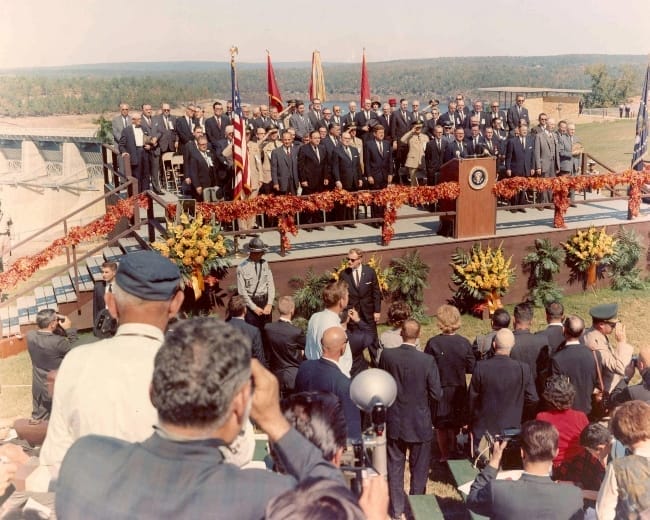
President Kennedy returned to the state in 1963 to dedicate Greers Ferry Dam. He drew a crowd of 5,000 to 10,000 people at the dedication ceremony, which celebrated the dam and the William Carl Garner Visitor Center. Later in the day, President Kennedy spoke to a larger crowd at the fairgrounds in Little Rock. This visit marked one of President Kennedy’s last public appearances before he was assassinated in Dallas in November.
Whistle Stop Train Tours
Several presidents took advantage of whistle-stop train tours to visit Arkansas, although some of those visits lasted only a matter of minutes.
Benjamin Harrison was the first president to visit Arkansas in this way. On April 17, 1891, he stopped briefly in both Little Rock and Texarkana to say a few words to the crowds gathered for the occasion. Harrison was on a month-long trip that took him through 21 states with 140 appearances.
President William Howard Taft also stopped briefly in Arkansas in 1909 at Union Station in Little Rock. Taft’s visit clocked in at 15 minutes and holds the record for the shortest presidential visit to the state. Still, a crowd of 15,000 gathered to hear the president’s remarks.
President Franklin Delano Roosevelt and First Lady Eleanor Roosevelt frequently traveled by rail during the president’s 12 years in office. In 1936, the couple arrived in Hot Springs by train to celebrate the state’s centennial. The stop was part of a larger campaign tour as FDR stumped for his second presidential election. Roosevelt visited Arkansas by train at least two more times, including a brief stop in Booneville in 1938. Roosevelt addressed the crowd from the back of the train on this quick stop. In 1943, he arrived by train at Camp Robinson for a troop inspection.

Arkansas.com details the location of each presidential visit through Presidential Pathways, whether for 15 minutes by train or as the state’s only elected president, Bill Clinton. Pick a president or two and retrace their visit. Each visit tells its own story about the history of Arkansas


We do the work.
You check your email.
Sign up for our weekly e-news.
Get stories sent straight to your inbox!



Like this story? Read more from Kimberly Mitchell
The Razorbacks are famous across Arkansas and beyond. Many sports fans...
Ernest James Harris was born in North Little Rock on May 24, 1928, the...
Eugene Feenberg was a celebrated physicist who saw the rise of Nazism,...
Join the Conversation
Leave a Comment